




If you own or manage an independent grocery store, marketing often feels like the last box to check off on a long to-do list.
But while you were busy handling deliveries, the family that just moved in three blocks over has no idea your store carries their favorite coffee. They ordered it online, because that’s what came up when they searched.
Grocery store digital marketing comes down to two goals: getting found by people who don’t know you yet, and giving your regulars a reason to keep choosing you.
The seven ideas below cover both without much money or time wasted.
How Does Digital Marketing for Grocery Stores Work?
Most marketing advice treats every local business the same way — get on social media and post consistently.
And while that’s still a useful tactic for grocery stores, a few quirks of the business mean you have to be more strategic about how you do it.
First, your customers likely shop for groceries every single week, so you’re not convincing anyone to buy groceries in general. Instead, you’re competing to be the store they frequent versus the big-box retailer two exits down.
And that means timing matters more than persuasion, since your window for any promotion is usually the hours right before someone shops.
Related Read: Personalized Promotions: The Why & How for Grocers
A weekend special announced Saturday afternoon, for example, misses everyone who already went out that morning — and your point of sale (POS) system’s reports can show you which days and hours are busiest.
What you feature matters as much as when. Shoppers judge your whole store on a small set of staples they buy constantly, called key value items, which usually account for just 5–15% of your SKUs. For most supermarkets, that includes products like milk, bread, and eggs.
Getting the prices right on those few items does more for your reputation than a sitewide sale — but be careful with promotions in fresh departments. Too deep a discount on cuts of meat, for example, can read like they’re all about to turn.
With those considerations in mind, let’s explore seven actionable digital marketing ideas for grocery stores in 2026.
1. Update Your Google Business Profile
Your Google Business Profile (GBP) is a free listing that appears beside search results and inside Google Maps when someone looks up your store.
It includes information like business name, address, hours, phone number, website link, photos, product listings, and attributes like curbside pickup or contactless payments.
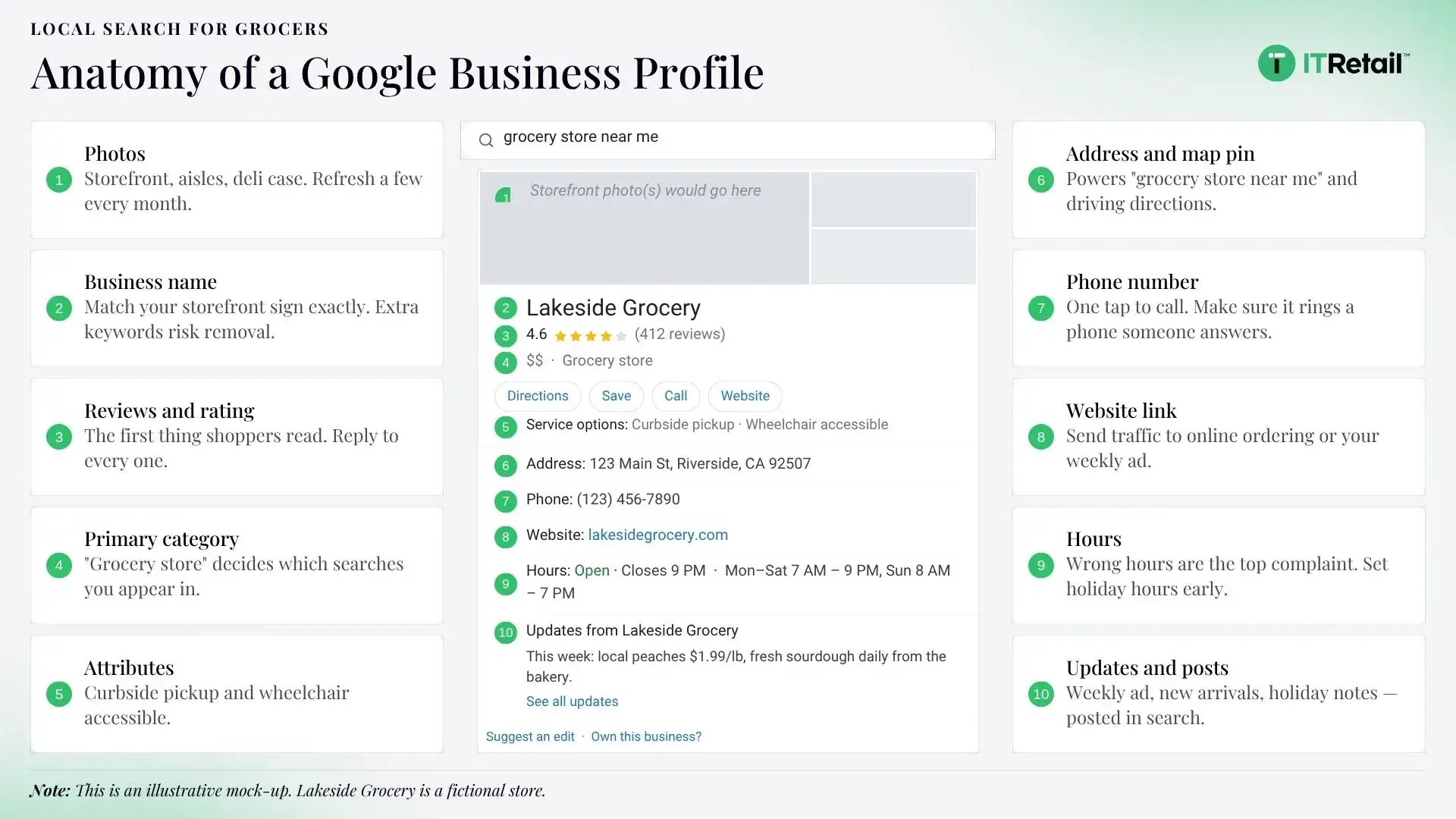
(Above is a mockup of a grocery store’s profile. Layouts vary by search query, so yours may appear as a map view rather than a side panel, etc.)
Note that, with 86% of Google Business Profile impressions coming from category-based searches instead of someone typing your store’s name, your categories often decide whether you turn up at all.
Once your basic information is accurate, these are the moves that do the heavy lifting:
- Pick the most specific primary category. You can add up to nine more, but two or three relevant ones like “butcher shop,” “fish market,” or “deli” beat stuffing the whole list.
- Upload your in-store products. Google shows retail inventory in local results, so shoppers can check stock before they drive over.
- Keep photos coming. Google names photos and videos as a ranking tip, and phone shots of the meat case or hot bar beat stock images.
- Be tactful about review requests. More reviews and better ratings help you rank higher, but incentivized reviews break Google’s policies and FTC rules.
To get more reviews, print a QR code for the register or your receipt footer and let your counter staff know they can ask for one directly — the best moment is right after a customer compliments someone by name.
Pro tip: Google publishes a full guide to local ranking factors to help you sort out where your time is best spent on the profile.
2. Optimize Your Website
The cornerstone of any grocery store's digital marketing campaign is a good website to point people to. But a website only earns you customers if people can find it in the first place, which is where search engine optimization (SEO) comes in.
Google reads your site to figure out what you sell and who you serve, then matches those pages against what people type into the search bar.
Related Read: Grocery Store SEO: 7 Tips & Tools for 2026
For a grocery store, most of that comes down to location and inventory:
- List your city clearly. Something like “an independent grocery store in [city, state]” near the top gives Google a location to attach you to.
- Create specialty pages. If shoppers search for products like halal meat or fresh masa, having a page with those key terms on it can bump your page up higher in search.
- Mirror your GBP. Google cross-references the two, and mismatches work against you.
- Check your site on mobile. That’s where most “near me” searches happen, so make sure everything is easily readable and accessible on your phone.
A grocery-specific POS system like IT Retail also connects to Local Express, Mercato, Freshop, and eGrowcery, so your item catalog feeds an online storefront instead of you having to build product pages one at a time.
3. Set Up a Compelling Loyalty Program
One major part of digital marketing is proper outreach, which requires customers’ contact information. And for most independent shops, this is where a loyalty program comes in.
For customers to opt in, the program has to be worth their while. A points-based system that takes two years before someone can earn a free pound of coffee likely won’t hold interest, but a standing discount on what someone buys regularly will.
Related Read: 5 Ways Digital Customer Loyalty Programs Help Grocers Sell More
Most grocery programs are points-based, where shoppers earn per dollar and redeem for discounts or free items. Some stores add tiered or paid memberships for their most committed regulars.
Either structure depends on your POS being able to look up customers by card or phone number and apply rewards at the register without holding up the line.
4. Use Text Message (SMS) Marketing
With an open rate of up to 98%, text message marketing is one of the most effective communication channels with your customers.
But there are important caveats. You only have 160 characters to work with, so there’s little room to promote anything other than the single offer itself — and since opting out takes one word, a text that wastes someone’s time can cost you access to that customer permanently.
That’s why text marketing works best for promotions like same-day markdowns, limited-time offers, pickup notifications, and holiday ordering cutoffs — about one text per week is a reasonable ceiling for a grocery store.
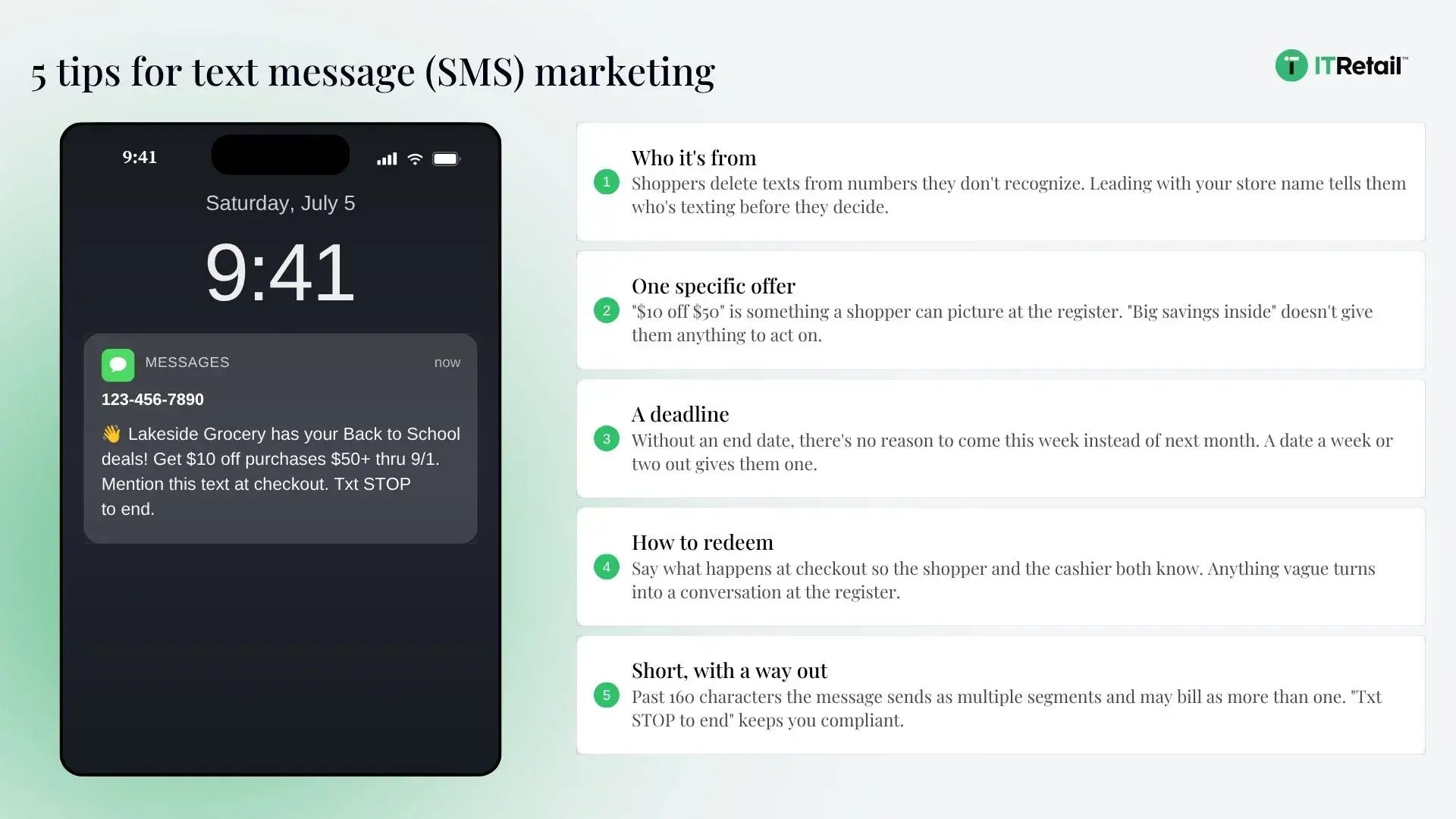
Compliance is crucial for SMS marketing. The Telephone Consumer Protection Act carries per-message penalties for texting anyone who never opted in, so collect written consent at the register or through your loyalty signup, include opt-out language in every send, and keep messages inside local business hours.
Your text also needs to clearly explain how the offer works, whether that’s a promo code, an attached image, or a line telling shoppers to mention the text at checkout.
Then, make sure your register can handle it, because a text promo your cashiers can’t ring up costs you a sale and that customer’s trust.
IT Retail includes bulk SMS alongside scheduled promotions, mix-and-match deals, and “buy X, get Y” sales, so the offer you text out is the same one your register already knows.
5. Refine Your Email Lists
Compared to text message marketing, which has to be short and actionable, email gives you a little room to breathe.
If you’ve never sent an email blast to your customers, a system like Mailchimp can help you set up a regular cadence.
A monthly newsletter is a great starting point, where you can include things like new or seasonal inventory, upcoming promotions and events, seasonal recipes, community spotlights, or even a photo of your employee of the month.
If you already send emails regularly, here are some quick strategies to improve performance:
- Remove unengaged contacts. Drop addresses that haven’t opened anything in six months, since dead contacts drag your sender reputation down and land future emails in spam.
- Repeat offers in text. Many email clients block images by default, so a circular pasted in as one big graphic can arrive blank.
- Segment by purchase. A 5 p.m. prepared-food shopper and a big Sunday trip shopper want two different emails.
- Test one thing at a time. Change the subject line or the send time, but never both at once, or you won’t know which one worked.
- Read your reports monthly. Open and click rates tell you which topics people care about most, and give you valuable info for future sends.
Segmenting gets a lot easier when your POS does the sorting. IT Retail collects email addresses at the register through digital receipts, then tracks last visit, total spent, and top products purchased — so you can export a targeted list straight into Mailchimp or any of the 86 other email services it connects to.
6. Promote Online Ordering and Pickup
Plenty of independent grocers already take orders online or by phone, but the option only helps if people know it exists.
Add curbside pickup as an attribute on your Google Business Profile, then say it clearly on your homepage and in your social bio instead of burying it several paragraphs down.
Related Read: Managing Curbside Pickup in Your Small Grocery Store: 7 Expert Tips
From there, the experience has to hold up. Test the ordering flow on your own phone to see how many taps it really takes, and set aside reserved parking so pickup customers know exactly where to go. You can also text customers when their order is ready so they know exactly when to come.
Social media is last in this list not because it matters least, but because it’ll likely be the biggest long-term lift.
The best place to start is research rather than posting. Pull up the Facebook and Instagram pages of a few independent grocers in your area or in similar markets, then notice which posts get the most attention.
What you’ll usually find is that people-focused content wins. Sierra Sterrett, digital marketing coordinator for Oregon-based Chester's Markets, told IGA that “our customers want to see the friendly faces of Chester’s, not what we have on sale today.”
Here are a few tactics from independent grocers doing this well:
- Highlight your staff. Employee of the week posts consistently outperform product photos at independent stores.
- Pin your weekly ad. It keeps your deals at the top of the page for anyone who lands there looking for them.
- Post a recipe and ingredients. A Caribbean store promoting a weekend oxtail special can bundle everything into a recipe card, turning one post into a bigger cart.
When looking for inspiration, borrow the format but not the exact content — the posts that work do so because they’re specific to that store and that community.
And pick a cadence you can actually hold. Two posts a week beats 10 posts one week followed by a month of silence.
Market Your Grocery Store With IT Retail
None of the above ideas require an extensive marketing budget or team, but they do require the right technology to get the word out.
A grocery-specific POS system like IT Retail helps you manage customer data, loyalty programs, email and SMS marketing, promotions, and online pickup and delivery. It also puts your sales history in one place, so the offers you send reflect what people actually buy.
If you’re ready to see how IT Retail can help your grocery store’s digital marketing efforts, schedule a free, personalized demo today.

 by Luke Henry
![How To Write a Grocery Store Profit and Loss Statement [+ Free Downloadable Template]](https://www.itretail.com/hs-fs/hubfs/_Blog/Blog%20Featured%20Images/IT%20Retail%20Blog/How%20To%20Write%20a%20Grocery%20Store%20Profit%20and%20Loss%20Statement%20SOCIAL.png?width=520&height=294&name=How%20To%20Write%20a%20Grocery%20Store%20Profit%20and%20Loss%20Statement%20SOCIAL.png)